The story behind
Don't Talk (Put Your Head On My Shoulder), according to DoReSol
When you dive into *Don't Talk (Put Your Head on My Shoulder)*, you encounter a piece that deviates from the conventional. The composition, by Brian Wilson and Tony Asher, explores non-verbal communication between two people in love. What makes it special is its harmonic complexity; Wilson considered it one of the most intricate he composed. Musically, it is distinguished by its use of a string sextet and a tonal ambiguity that challenges clear identification of its main key, although it leans towards G-flat major. The instrumentation is rich, with guitars, vibraphone, timpani, organ, piano, double bass, a drum cymbal, and the aforementioned strings, all recorded at Western Studio in Hollywood. It's interesting to note that on this song, as on two other tracks from the album, the lead vocal is the only one from the Beach Boys present.
The recording of *Don't Talk (Put Your Head on My Shoulder)* took place between February and April 1966, and it was produced by Brian Wilson himself. He sought a vocal expression that sounded more feminine, an intention he managed to capture in the performance. Wilson himself compared the general mood of this song to his 1963 track, *Lonely Sea*, noting an emotional connection despite the different arrangements. The lyrics, according to Tony Asher, stemmed from a curiosity to write about the absence of words, but they managed to capture that intimacy. Brian's performance, with a voice he described as innocent and youthful, evokes that closeness which Marilyn Wilson, his then-wife, called romantic. The phrase 'Hear my heartbeat' was particularly significant for Brian, who considered it part of one of his sweetest songs. Critic Geoffrey Himes describes it as a ballad where Brian sings in a devoted tenor, capturing that romantic moment when words are superfluous. For his part, biographer Timothy White sees in the lyrics a meditation on romantic tranquility or a reunion song, while author Jim Fusilli suggests it can be interpreted as a farewell, what is said when one knows it's the last time. The rhythmic structure is subtly supported by a brush-played cymbal, marking a 12/8 time signature that is felt more in the melody than in explicit percussion.
From album

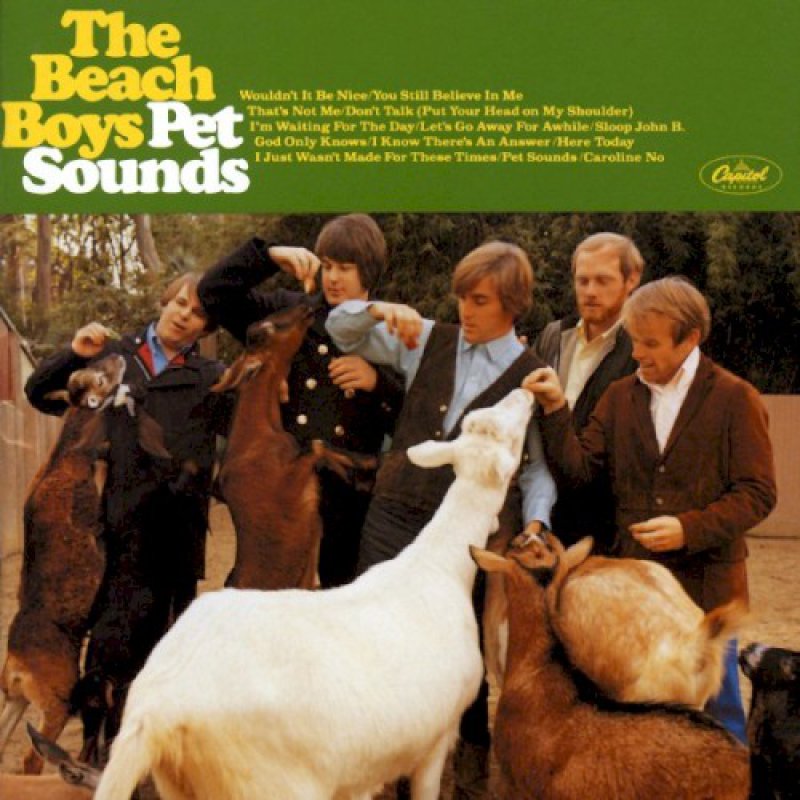
Pet Sounds
The Beach Boys · 1966 · Track 4
Details
Credits
Music Brian Wilson, Tony Asher