The story behind
Rock Around the Clock, according to DoReSol
That guitar intro that jumps like a rusty spring, that bass that pushes nonstop, and that drumbeat that sounds like a miniature pneumatic hammer: Rock Around the Clock doesn’t sound like a song, but like the first day the world heard rock and roll. Recorded in April 1954 in a borrowed New York studio, Bill Haley & His Comets’ version didn’t invent the rhythm, but packaged it so directly that even a 1950s teenager got it: dance until your body gives out. The original title, We're Gonna Rock Around the Clock Tonight!, already made it clear: this wasn’t just any track, it was an invitation to lose track of time between distorted guitars and choruses that screamed more than they sang. When it hit the market in May 1955, no one expected that two-minute-and-nine-second single to become the first rock song to reach number one in both the United States and the United Kingdom simultaneously. Even less so that, decades later, the U.S. Library of Congress would declare it “culturally significant” for being one of those rare moments when a song transcends its era.
The story behind the recording has more twists than a circle dance. The song was written in 1952 by Max C. Freedman and James E. Myers (the latter under the pseudonym “Jimmy De Knight”), but fate had Bill Haley unable to record it for two more years. Myers swore he composed it with Haley in mind, but legal issues with producer Dave Miller—who refused to let it be recorded on his label—delayed everything. When they finally stepped into the Pythian Temple studio in New York, they did so with borrowed equipment and extra pressure: they knew they needed something that sounded unlike anything on the radio. The result was a track that, in its original version, lasted just over two minutes but packed the energy of a live concert. The curious thing is that the melody of the chorus wasn’t new: it suspiciously resembled Move It On Over by Hank Williams (1947), a detail many attributed to the country tradition of reusing rhythmic patterns. But Haley and his Comets gave it the definitive twist: less ballad, more controlled chaos. When it was included in the 1955 film Blackboard Jungle, the effect was instant. Young people of the time adopted it as an anthem of rebellion, and though Haley had already had minor hits like Crazy Man, Crazy (1953), this was the one that truly opened the doors of the mainstream to rock and roll. By the time it was re-released in 1974, it was already a classic that still sounded fresh, as if time had never passed it by.
From album

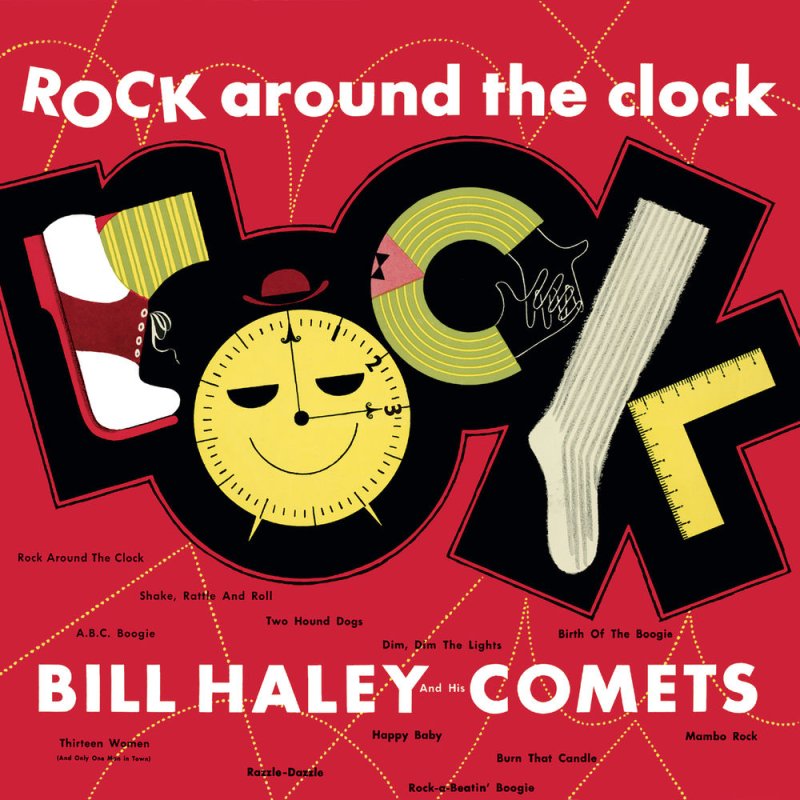
Rock Around the Clock
Bill Haley and His Comets · 1956 · Track 1
Details